
Karmic Relationship Patterns and Nakshatra Influences: A Person Case Study of Trauma, Ancestral Imprints, and Marital Destiny
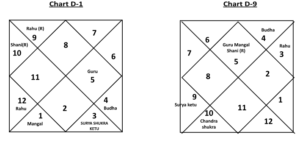
Birth Framework and Nakshatra Configuration
The native’s horoscope reflects a complex karmic and emotional blueprint shaped strongly by Nakshatra placements. The ascendant falls in Anuradha Nakshatra, while planetary positions are distributed as follows:
- Sun – Ardra
- Moon – Revati
- Mars – Bharani
- Mercury – Punarvasu
- Jupiter – Purva Phalguni
- Venus – Ardra
- Saturn – Dhanishta
- Rahu – Mool
- Ketu – Ardra
This distribution highlights repeated activation of intense, transformative lunar mansions such as Ardra, Bharani, and Mool, indicating deep karmic processing.
Consultation Omens and Panchang Signals
On the day of consultation, the native experienced domestic discord, and a ritualistic symbol (sindoor) fell during worship. From a traditional astrological lens, the operative Panchang energies linked to Venus and Ketu suggested disturbances connected to marriage, harmony, and financial stability. Such omens are often interpreted as symbolic reflections of ongoing karmic imbalances rather than literal predictors.
Ascendant Nakshatra and Psychological Imprints
Anuradha rising often signifies devotion, emotional persistence, and the carrying forward of unfinished relational desires. Symbolised by the lotus, this Nakshatra reflects the capacity to rise through adversity. Individuals with this ascendant frequently encounter emotional trials that shape resilience and spiritual maturity.
Placement of the ascendant lord in the sixth house reinforced themes of conflict, family discord, and psychological strain. The native confirmed recurring disputes within the household, validating the astrological indication of relational turbulence.
Family Relationship Patterns and Ancestral Echoes
Mars positioned in Bharani Nakshatra introduced themes of karmic intensity within family bonds. Bharani, symbolically linked with restraint, transformation, and moral testing, often manifests through emotionally heavy relational experiences.
Navamsha correlations further reinforced a 1–5 linkage involving Bharani energy, pointing toward repeating cycles of relationship distress across generations. Reports of parental discord and unstable partnerships aligned with this configuration.
Additional eighth-house influences involving Sun, Mercury, and Ketu suggested secrecy, emotional fragmentation, and unresolved ancestral narratives affecting the family system.
Unresolved Ancestral Trauma Indicators
Astrological symbolism suggested the presence of unsettled feminine ancestral energy—often interpreted traditionally as incomplete closure surrounding a deceased female family member. Whether taken literally or psychologically, such symbolism reflects inherited grief, guilt, or emotional residue persisting within family consciousness.
These imprints tend to manifest as recurring domestic unrest, emotional heaviness, or relational fear in descendants.
Tantric and Spiritual Symbolism in the Chart
Despite belonging to a different religious background, the native reported proximity to powerful Shakti worship spaces and personal inclination toward esoteric practices. Ardra and Bharani placements, along with Rahu in Mool, frequently correlate (symbolically) with exposure to intense spiritual or occult environments.
Such placements do not mandate practice but indicate psychological openness toward transformative or shadow-work pathways.
Trauma Signatures in the Horoscope
Mars in Bharani within the sixth house—combined with Rahu and Jupiter influences—reflected stored trauma linked to violation, fear, or bodily insecurity. When asked sensitively, the native acknowledged childhood assault by a relative, aligning with the symbolic reading of suppressed pain and karmic vulnerability.
Astrology, in this context, functioned not as proof but as a reflective language for articulating psychological wounds requiring healing.
Marriage Prospects and Timing
Despite relational fears, marriage potential remained active. Predictive assessment highlighted a favourable period when Jupiter’s transit and dasha activation aligned with Mars (significator of spouse in the chart framework used).
Marriage was projected during that cycle and later confirmed to have materialised, validating the timing technique applied.
Remedial and Therapeutic Measures Suggested
Remedies were prescribed symbolically to stabilise Mars and Venus energies while promoting psychological grounding.
Mars-Related Measures
- Installation of a sacred plant symbolising purification.
- Placement of a protective deity idol beneath it.
- Creation of geometric yantras over consecutive days.
- Recitation of protective hymns and ritual light offerings.
- Final ritual dissolution symbolising karmic release.
Venus–Ketu Balancing Practices
- Installation of a crystal Shiva symbol.
- Ritual water offerings with healing mantras.
- Symbolic release exercises involving written negativity and immersion practices.
Such measures functioned both spiritually and psychologically—encouraging emotional catharsis, focus, and faith-based coping.
Outcome and Client Feedback
Within months of consistently following the prescribed practices:
- Engagement was finalised.
- Anxiety levels reduced.
- Trust in relationships improved.
- Emotional stability increased.
The native reported a renewed sense of hope and relational openness.
Analytical Conclusion
This case illustrates how Nakshatra layering, divisional correlations, and karmic symbolism can be synthesised into a holistic narrative addressing:
- Relationship trauma
- Ancestral imprints
- Psychological wounds
- Marriage timing
- Remedial pathways
Rather than deterministic judgment, such analysis serves as a reflective framework—guiding individuals toward awareness, healing, and conscious life decisions.

You may also like
Lagna / First House – The Anchor of Life & Personality